It would have been easy, even in 1997, to discount Fleetwood Mac’s Phoenix-from-the-flame resurrection. Yes, it had been, at that point, almost 7 years since their last quasi-hit album, the Top 20 Buckingham-less BEHIND THE MASK, and a full decade since their last Top 10 (1987s TANGO IN THE NIGHT). Their last #1, MIRAGE, was in 1982. But the Mac’s legend supersedes such frivolities. One should never underestimate the power of hundreds of millions of sold albums, or a Rock n Roll soap opera nonpareil. Fleetwood Mac might have been dinosaurs by the late 1990s, but they were far from extinct.
Of course, with all the turmoil that imploded the band, it was a pipe dream for any ardent Mac fan to ever hope that the classic line-up – obviously its most artistic, and not to mention, lucrative – would ever reform. McVie retired in her English castle, Buckingham was busy with his own career, and Nicks had her own solo career with varying degrees of success, half of which was riddled with drug addiction and recovery.
This lineup’s last public performance was at the request of the White House. Throughout his campaign for president, Bill Clinton used “Don’t Stop” as his official theme song, and President-elect Clinton requested the Mac perform it at his 1993 inauguration. But reuniting wasn’t even on their radar.
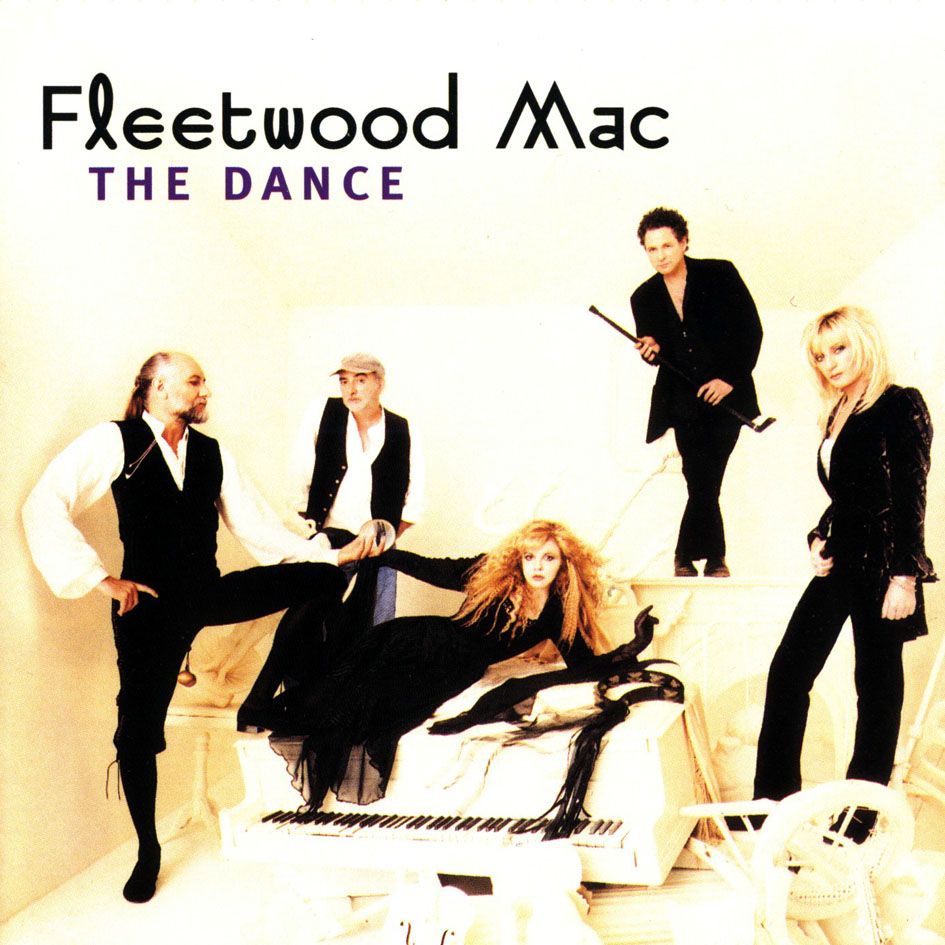
But, reunite they did, and the result was a wonderful live album called The Dance. The Grammy-nominated CD hit #1 and a refreshed, healthy, sober and exhilarating Fleetwood Mac embarked upon a comeback for the ages, mounting a monumentally successful tour and reigniting the world’s passion for the classic assemblage.
In the following clips, Stevie Nicks, Lindsay Buckingham, Christine McVie, John McVie and Mick Fleetwood are interviewed in North Hollywood, California, during their rehearsals that begot the CD and live TV concert. The interview took place on April 18 1997.
Enjoy these rare, behind the scenes interviews and performances from Fleetwood Mac!
Too often, early in her career, too much emphasis was focused on Dolly Parton’s facade, rather than her music. That always irked me. Remove the glitz, de-glimmer the glamour, abandon the wigs, and disregard the tits (and forget the plastic surgery) and what you get in Dolly is one of the singular greatest forces of nature in the history of Pop or Country – not only a singer for the ages, but a songwriter nonpareil.
Of course the world recognizes Parton’s unabashedly proud garishness. As Stephen Sondheim once wrote, “You Gotta Get A Gimmick”. But unlike the siren strippers in GYPSY, Parton was never dependent on gimmickry as a pathway to mega-stardom – she merely sprinkled it on a little something extra. And, too, no one cannot depend on such stratagem on the path toward iconic status. It takes a helluva lot of genius and talent to back up such hosannas.
And for nearly 5 decades and going strong, Parton has made a comfortable home upon the mountaintop of Country Music and sustained where few have – living immortality.
Country music is one of the purest of American art forms and Parton its Norman Rockwell, for few have been able to paint such archetypal songscapes that would require an elongated scroll utilizing the most revered superlatives.
Already established as a Country Music icon, even in 1977, she was slowly penetrating Pop culturism (to the extent that “Pop Culture” existed in 1977) – countless TV appearances, film, and even adding Pop and Disco to her musical oeuvre (“Here You Come Again” and “Baby I’m Burning” respectively, as examples). The force still hasn’t stopped – happy for us.
Parton’s popularity has never waned across the world. In 1977, she appeared on the popular West German music show Der Musikladen (which was the continuation of the defunct Beat Club). The extraordinary thing about watching these clips – over three decades past – is how astonishing Parton’s voice has remained almost exact. Her vocals have aged in knowledge only – but that timbre, that soul, that range and that innate lovability, even in the face of adversary – remain astonishingly clarion-like.
Enjoy this rare and enchanting concert~
Parton covers Jackie Wilson’s 1967 soul classic, which was recorded for her #1 Country album, 1977s NEW HARVEST…FIRST GATHERING~
Dolly sings the title song of her 1976 album ALL I CAN DO; both the album and the single reached #3 on the Billboard Country Album charts and Singles charts respectively~
Dolly performs the classic title song from her 1974 album JOLENE; the song reached #1 in 1973 before the album was released. It is ranked #217 on the Rolling Stone magazine’s list of “the 500 Greatest Songs of All Time“.
“My Tennessee Mountain Home” was a #15 Country Hit and the title track from her 1973 album of the same name, which hit #19 on the Billboard Country Album charts.
“Do I Ever Cross Your Mind” was a song that Parton wrote and performed in the 70s but never recorded until the early 80s (on her HEARTBREAK EXPRESS album) and reached #1 on the Country charts in 1982 as a double-A side companion to her re-recording of “I Will Always Love You” for the soundtrack of THE BEST LITTLE WHOREHOUSE IN TEXAS. Here, Dolly performs the song in it’s regular “45RPM” speed, then at “78RPM”. Delightful.
“Coat Of Many Colors” was a #4 Country hit, released from her #7 Country album of the same name. Released in 1971, it remains a staple in her live shows and displays, early on, in depth and in detail, what an astounding songwriter Parton is.
“Apple Jack” is a cut from Parton’s #1 Country album, 1977s NEW HARVEST…FIRST GATHERING~
“Light Of A Clear Blue Morning”, in the original incarnation of her #1 Country album NEW HARVEST…FIRST GATHERING, is my favorite Parton song. Her vocals soar, the melodies morph from bittersweet contemplation to eventual exaltation. Oddly, it only reached #11 on the Country charts. Parton re-recorded the song twice, to lesser degrees; first for the soundtrack of her 1992 film STRAIGHT TALK, then again for her 2004 ‘spiritual’ CD FOR GOD AND COUNTRY.
“I Will Always Love You” is Parton’s signature masterpiece. Nothing needs to be said of it.
“Getting In My Way” is a track from Dolly’s #1 1977 NEW HARVEST…FIRST GATHERING LP.
“Me and Little Andy” is a track from Dolly’s mega-successful pop-crossover LP, 1977s HERE YOU COME AGAIN.
“How Does It Feel” is a track from Parton’s #1 1977 NEW HARVEST…FIRST GATHERING LP.
Dolly closes the show with “Holdin’ On To You”/”The Seeker”, a medley of two tracks from two Parton albums. “Holdin’” is taken from Parton’s 1977 NEW HARVEST…FIRST GATHERING and “The Seeker” is a track from her 1975 DOLLY: THE SEEKER/WE USED TO.
Released in 1982, after a short hiatus following the successful TUSK tour, Fleetwood Mac’s MIRAGE brought them back to the #1 spot on Billboard’s Top 200 chart, something that eluded them since 1977s mega successful RUMOURS LP, which remains one of the Top 5 selling albums in history.
The first single was the Christine McVie/Robbie Patton-penned “Hold Me”, which reached #4 on Billboard’s Hot 100, and remained there for almost 2 months (it was the 31st biggest single of that year). With McVie’s husky, smoky delivery and her impeccable gift of writing great pop melodious gems, “Hold Me” remains one of Fleetwood Mac’s most indelible classics.
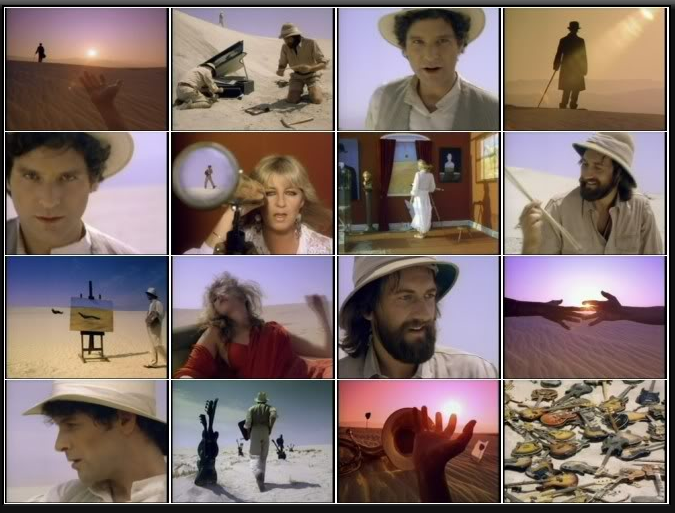
In the summer of 1982, with temperatures reaching more than 100 degrees, director Steve Barron (who had recently directed the classic video “Don’t You Want Me Video” for the Human League) took Fleetwood Mac to the Mojave desert to shoot the video for “Hold Me”; the video, like so many other videos from that era, makes little-to-no sense, especially when married to the song. John McVie and Mick Fleetwood goofily “play” archaeologists unearthing ancient guitars. As Christine spies through a telescope, Lindsay paints Stevie in the blistering heat, then Stevie paints Stevie in the blistering heat, who then in turn, traipses across the desert in her red platform boots carrying her canvas. It was/is all quite ridiculous, but the video was a huge hit for MTV at the time and remains a fan favorite.
Barron directed other classics of the early days of music videos, such as a-ha’s “Take On Me” and Michael Jackson’s “Billie Jean”, but “Hold Me” is inexplicably left off of his Wikiepedia page.
In this rare behind the scenes dailies, Barron directs a breathtakingly beautiful Stevie Nicks for some of her scenes in the video. Stevie’s was the only footage I was able to unearth. The clapper board dates this as June 24, 1982.
I cannot remember a time in my life where I could sleep in silence. To drift into timelessness, there must be the delicate sounds of human language…music never helped either, and still doesn’t…it has to be conversations in the dark, like angels converging in my timespace. Now, and since the genesis of my adulthood, I sleep with the television playing old reruns through the night (until Rob comes to bed and shuts everything down), but as a teen, with no TV in my room, I would drift into dreamland by listening to talk radio or, in many cases, the local all news station.
And I heard it in the middle of the night, awoken while listening to New York’s all-news 1010 WINS…and I was paralyzed. Was this a nightmare? I tended to drift between reality and dreamscape, sometimes unable to momentarily grasp the difference between the corporeal and the intangible dreams…
No, this had to be merely the night terrors, brought on by the incessant tick-tick-ticking of WINS’s archaic background sound effects. I jettisoned out of bed, ran to the bathroom, splashed my face with water and sighed, lumbering back into the sanctuary that was my bed on the floor. But I had to be sure. So, I listened again.
And I wept in the silent hollow of the night. How can John Lennon be dead?
The next school day was a day of mourning, as students and fans sat around the piano in the auditorium singing the songs the world knew. No one could believe that he was gone…murdered…why a man who lived his life for peace and love would be so mercilessly executed. In hindsight, and to anyone not born of that time, this might all seem a bit idealistic, but it served the youth of the world back in the prehistoric, pre-Internet era of 1980.
It’s unfathomable that almost three decades have passed since madman Marc David Chapman put a bullet through the very fabric of an era.
The world lost not only a philanthropist, but those who loved his music, his philosophy and his inherent goodness also lost a fabric of their innate being.
And, more tragically, a woman lost a husband and a little boy lost a father.
The abundance of tracks that were recorded during the sessions that begat the John Lennon/Yoko Ono classic DOUBLE FANTASY were supposed to be released successively as sort of companion pieces, and in January of 1984 – four years after Lennon’s slaughter – Ono finally released MILK AND HONEY, accumulating John’s songs from those sessions with her (mostly) new songs. Musically it was a strange dichotomy – Lennon’s sonically unfinished tracks were hardly masterpieces, though there were some gorgeous moments. Ono’s newer tracks hinted at a more contemporary feel while subsiding (though not totally) her usual avantgardism for a more Pop sheen (though hardly Pop). Juxtaposed as the same call and response schematic as DOUBLE FANTASY, MILK AND HONEY, at times, loses a coherency. And I admired the collection for these exact reasons. Reviews were mixed, and many pondered the motives around Ono releasing this material (she talks about such in the interviews below).
For over four decades, Ono’s unfairly been a pariah to psychotic Beatles fanatics, Lennon-ologists and journalists, and still, to this day, by muttonheads who stupidly continue to espouse the “SHE BROKE UP THE BEATLES!!!” mantra like the 33 of “Revolution #9” played on 78 (forget that some of Lennon’s finest musical seeds were nourished after the dissipation of the Fab 5, thanks to Ono as inspiration).
What was – and is – almost always overlooked was their happily-ever-after. If anything at all, it was indubitable that John & Yoko were passionately in love with each other and their son, until sadly, what transpired was their Till death do us part.
Certainly, Ono was (and is) not unaware of the conspicuous disdain the majority of the public feels at the mention of her name or the mockery at the suggestion of her musicality – though I’m apt to believe most negative connotations, especially these days, come from a force of habit, as if it were merely common knowledge to loathe her – but she rarely, if ever (and certainly not during this interview) lets her guard down or lets the toxic forces imbibe her tightly sealed bubble (at the time of this interview, she’d had almost two decades of such barrages to have already built up massive invisible force shields).
Some also scoffed because this was a paid interview – Robert Christgau, the Dean of American Rock Critics, was commissioned to interview Ono by Ono herself, for this promotional film for MILK AND HONEY. In his weekly Village Voice Consumer Guide, dated March 24, 1984, Christgau wrote:
“* * * Attention * * * Disclosure * * * Attention * * * Before the goddamn Times finds out, I’ll do the apparently honest thing and note that I was paid by Yoko Ono to interview her for a promotional film she’s making about Milk and Honey. I took the job well after (and only because) I’d fallen for the album, though the interview clarified my ideas about it. For a while I considered not reviewing Milk and Honey, or keeping my opinion off in some discreet corner, but in the end it seemed stupid, not to mention ethically dubious…”
Christgau gave MILK AND HONEY an “A” grade in his Village Voice Consumer Guide.
Besides Yoko, Christgau also interviews Sean, who at the time was a precocious 9-year old, wise beyond his youth. But these interview segments are fairly brief, and woven with home movies of Lennon and Ono and Sean (some of the footage I’ve never seen) that are both wondrous and heartbreaking. They exist as aural and visual paintings – from “Nobody Told Me” to “Borrowed Time,” to “Grow Old With Me” to “I’m Steppin’ Out.” Presented almost as music videos, these are rare glimpses of a sojourner’s happy past and present that numbs in the realization that he – and we, and Yoko, and Sean – were robbed of a spirited, almost assuredly monumental, enchanted future.
Interviewed in Los Angeles, on May 11 1985, a few months before the release of her 3rd solo LP ROCK A LITTLE, Stevie Nicks – the Rolling Stone-anointed “Queen Of Rock & Roll” – takes on a myriad of subjects.
In part 1, Stevie discusses the hopefully-imminent release of ROCK A LITTLE and what that means, working with her band and the recording of a few of the tracks in a Dallas church, with Jimmy Iovine, music videos (at this point, the first single wasn’t even chosen – eventually it was “Talk To Me”, which hit #4 on Billboard’s Hot 100) and touring, the surge of women in Rock N Roll that year and how Fleetwood Mac helped her become the rock star she is and how they protected her as “the little sister.”
In part 2, Stevie discusses her influence on other artists and how she hopes that, through her energy – if not her singing – those artists could learn something; her fashion influences (Madonna gets out of such comparative influences easily, Prince does not!), the admiration she has for up-and-coming newbie Cyndi Lauper’s strength and Tina Turner’s tenacity and fortitude. She also happily discusses her back-up singers Lori Perry and Sharon Celani (and “Minnie” – you have to watch) and how having them as friends and support make her life so much easier, and the relations and alleged competition between women in general, in music and in life.
She also discusses where her passion for her love of painting comes from, how it sedates her and grounds her and how it’s never been an innate ability or desire until only a few years prior. She opens up about how this passion started due to the sickness of her friend Robin (whom she doesn’t mention by name) and how she started drawing so, when Stevie could not be with her, the image of her drawings kept them connected. She “summons” Sister Honey for the interviewer (which can be seen in the next part of the video), a painting that has become a favorite over the years for Nicks’ fans.
The video is damaged around the 7 minute mark in part 2, but it’s only briefly – and you can still hear the audio.
In the final part, her painting Sister Honey is brought into the room and Nicks explains her origins and again states that this is all (painting, that is) still very new to her. Stevie is then asked about her “book that is coming out”, called “The Wild Heart” and its contents:
“A lot of poetry, it’s some journalistic stuff; it’s a lot of the actual nights of recording of THE WILD HEART and the experiences that happened during that 2-3 year period. There are some things from my Fleetwood Mac stash of 10 years of writing….the real essence of that isn’t in this book because that’s a book in itself…it’s my life, and it’s very honest.”
The book has a lot of “advice” and “philosophy” and a way to “give a little bit more of me”. She’s “very excited about them (her fans) receiving it” more than actually putting it out. (We fans have been wishing for years for any book from Stevie – but sadly, “The Wild Heart” was never published.)
She talks about what she does in her down time – which is a foreign concept to her. She’s been working non-stop for over a year and a half, and hopes to take a vacation when it’s over. She talks a little about love, and the possible resurrection of Fleetwood Mac and the bond they share…and how she liked Christine McVie’s solo album and loved the video for McVie’s “Got A Hold On Me” video.
Before the interview is over, Stevie wants to add an an addendum to her earlier philosophy of love, and how she doesn’t want anyone to misinterpret that it’s an impossible ideal – she does believe one can find it…one just has to look hard.
I got flack for it in 1999 from my ‘serious’ music-loving friends and I’ll probably get flack for it again – but I’m owning it! Back in 1999, during the genesis of the new(est) wave of boy band hysteria, LFO’s (oy, that stands for Lyte Funkie Ones) “Summer Girls” left an indelible, deliciously cheesey mark on the TRL-saturated terrain of teen pop. Sure, it was lyrically stupid and sophomoric, but it read like any teenage boy’s stupid, sophomoric love letter to his girl. And it was one of my Top 10 Singles of that year.
Sadly, Rich Cronin – lead, uh, ‘singer’ – died earlier today at the age of 35 after being diagnosed with Acute Myelogenous Leukemia in 2005. Cronin – and LFO – never again reached the highs of “Summer Girls” (though came close with the Top 10 “Girl On TV” – the video starred Cronin’s then-girlfriend Jennifer Love Hewitt) – the monumental royal battle between the Backstreet Boys vs. ‘N Sync was too mighty for the minuscule armies who attempted to reach that hierarchy, where even the semi-successful ones (e.g. the gruesome 98°) were scoffed and decimated. Cronin did appear in the short-lived 2007 Vh1 reality show MISSION: MAN BAND, which consisted of other former teen-pop boy band members and chronicled their attempt at one last shot of superstardom.
Sadly, for Cronin, it never happened, though it was said he enjoyed the ride. I’m glad. RIP, Rich. And as for “Summer Girls”, thank you for that little piece of goopy heaven.
Dobie Gray’s version of “Drift Away” is, justifiably, the most famous and, by far, the most brilliant reading of the Mentor Williams-penned (that would be Paul Williams’ brother) 70s staple. Originally released on John Henry Kurtz’ 1972 REUNIONalbum, the indelible classic always takes me away…to that far away place I used to reside – within the deepest caverns of my soul. At times the song makes me weep, as I miss the halcyon days of my youth and the kinder world we thrived in. When any ills of the world would be swept away when reaching for your LP of your favorite music was all that was needed to, well, drift away.
And when my mind is free...you know a melody can move me...and when I'm feelin' blue...the guitar's comin' through to soothe me...
The song was covered hundreds of times these past 40 years, most famously and recently in a passionless 2003 recording by Uncle Kracker. Credited as Uncle Kracker featuring Dobie Gray, the track meandered along in karaoke sterility until finally Gray’s soul chimed in mid-point and he infused it with a thrilling tremble. When the track reached #9 on Billboard’s Top 100, Gray broke the record for the biggest gap between top US top 10 appearances (it had been 30 years between both). The Kracker version had a far more major impact on Billboard’s Adult Contemporary charts – it holds the record as the longest #1 on that chart, having reigned for 28 weeks in 2003-04. No doubt thanks to Gray.
There was a story told by Kracker that the song was initially written for Elvis, but Presley turned it down once he heard Gray’s version of it. Gray was a demo singer in Memphis at the time. Talk about decree.
Gray’s had a decades-long career. While never matching the mega-success of “Drift Away” (Uncle Kracker notwithstanding), he’ s recorded dozens of albums. HERE is his Wikipedia page – spelunk and learn.
I enjoy Cee-Lo Green’s “Fuck You” much better than Lily Allen’s “Fuck You” for the aesthetic alone. Yes, I know, apples and oranges, (I LOVE Cee Lo and Lily both) – two different songs, two different genres, too different , uhhh…messages?
Cee-Lo Green is a gifted soul singer – this is indisputable to anyone whose heard him throw down his gritty Southern Fried soul, hearkening back to the greats of the 60s and 70s. So, it’s no wonder that his latest single juxtaposes that old school aesthete with, say SCHOOL HOUSE ROCK. “Fuck You” has an indelible melody and Cee Lo’s delivery is fierce, ferocious and funky. Just don’t sing along too loudly on your iPod.
Anyone who followed my AMERICAN IDOL REPORT CARD back in season 8 knew my adoration for 3 of the Top 4 finalists (the less spoken of Danny Gokey, the better for my indigestion). I considered Kris, Adam and Allison the great triumvirate – the Power of 3.
Last year, Joe Zee from Elle Magazine sat down with the three for some conversation. An edited video was posted on Elle’s own YouTube page, but since I had access to the actual full interviews, I decided to upload them to my own YouTube page for the fans of this terrifically talented trio.
Almost a year later (these interviews were conducted in August of 2009), but as the cliche goes, better late than…oh, you know.
I saw Glenn Close as Norma Desmond in the original Broadway production of Andrew Lloyd Weber’s flawed, overtly dismal SUNSET BOULEVARD the week it opened back in November 1994, and, despite her suspicious Tony Award win, it was not a very good performance (I saw her twice in the role just to verify/refute my initial reaction). They seemed to lower the key for her limited range, rearrange the score, and, more often than not, Close seemed lost in the grand spectacle of the staging, something she wasn’t used to as a more intimate stage actress. The show was beneath her skills as an actress, too. It needs to be said that Close was only one of two actresses nominated as Best Actress in a dim year for musicals (the other being Rebecca Luker for SHOW BOAT) and Broadway overall, so her Tony wasn’t unexpected.
Cover of PATTI LuPONE: A MEMOIR
How Close garnered the role is legendary in itself…I just finished reading an advance of Patti LuPone’s autobiography, PATTI LuPONE: A MEMOIR (release date is September 14 – if you’re a theatre buff, PRE-ORDER IT! It’s craaaazy!), who reiterates the horror that was the experience of the show – especially the back-stabbing and the mendacity attributed to the producers and, especially, Webber himself. The chapters of LuPone’s book were a mesmerizing read.
Once Close left the role, in stepped Betty Buckley – and I was astonished at what she was able to do bring to it. She resurrected Norma back to life. Long a Broadway legend for her supernatural voice, Buckley’s performance was stunning, each song a show-stopper.
According to LuPone, she was treated like garbage by Weber and his evil minions – and Broadway will never know what they missed in a Patti “Norma.” There are some YouTube clips posted of her performances that give us a minute taste of what this incandescent lady might have accomplished had she been given the chance.
And here’s a mere taste of what I experienced with Buckley in the role. I’m not sure if this was from the London production, or from Broadway – I downloaded this clip from YouTube, and the poster didn’t say. The audio was low, so I encoded it at a much higher rate.
To witness Buckley on stage is to be beholden to one of the greatest forces of nature…an unparalleled gale force. From her Grizabella in CATS, to her staggering Emma in SONG & DANCE (she replaced the great Bernadette Peters), I’ve been enchanted by them all. I was there opening night for the much-maligned CARRIE too, and, while the show is legendary for all the right/wrong reasons, I’ll never forget Buckley as Margaret White. I adored her in the short-lived TRIUMPH OF LOVE in 1998, and of course in THE MYSTERY OF EDWIN DROOD a decade earlier.
Betty Buckley can easily brilliantly interpret even the most monumental banalities. Like an Andrew Lloyd Webber score.




 *****
*****




 My New Boyfriend