



I’m not writing full reviews, or writing about, every Oscar Screener I’ve seen. Just some notes I’ve jotted down after watching these particular films. Better writers and critics have better blogs and reviews than I’ll ever muster up the time for.
Roma is a rhapsody, really. A haunting beauty of an experience. It is both tone poem and homage, a tribute to Alfonso Cuaron’s childhood in Mexico.
It is personal and intimate, expansive and epic, gorgeously shot in a brilliant monochrome that is as much at the heart of the film as Mexico itself, and as the understated simplicity of its performances. (And in her first film role, Yalitza Aparicio is a revelation. That she’s not a contender during this award season is a mystery.)
Some have criticized the film for its inertia (which is ridiculous, as it is swathed with life) and for not having any real climax but, for me, it doesn’t need one. Life is beauty, life is heartbreak, life is resilience. Life is…simply life. The morning will come; it has no choice.
My grade: A
That sound you hear? That’s me eating my hat.
A few years ago, while watching the worst season of AHS (which still holds true today. I know – tough decision!) I said:
“Watch Lady Gaga lumber along in a comatose, hooker-in-headlights daze, every Wednesday, only on FX! Her “acting” makes Madonna’s look like Meryl Streep. (I only invoke Madge’s name because she’s possibly the worst pop singer-turned-actress in the history of cinema.)”
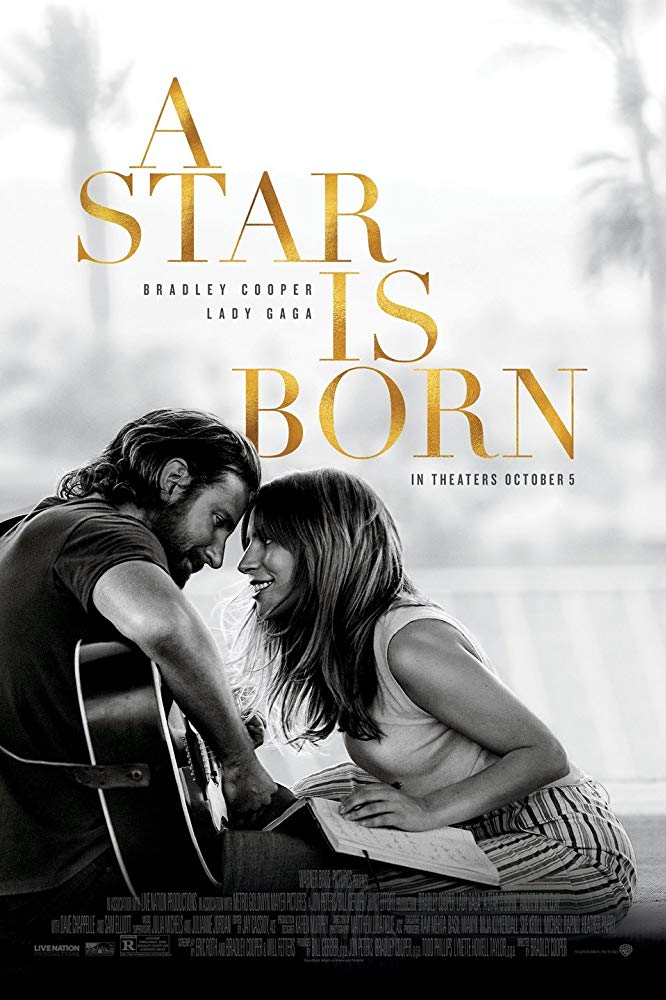
Well, I’ll be damned! Do I stand corrected! Well, not “corrected” – I steadfastly abide by my words about her and AHS. But, behold, she was fantastic in A Star Is Born giving a natural performance that went beyond pop-melodrama – it was authentic, and she navigated the complexities of the character beautifully. And, Bradley Cooper was another revelation. I realized he can act only after watching Silver Linings Playbook, and with each succeeding role, he proved his talent, even if the film in question was subpar. This, though, was his greatest role yet – raw, passionate, internal, tumultuous and empathetic.
And, more importantly, their chemistry was palpable – you believed in their romance, their passion, their tears, their battles, their redemption, their love songs – Cooper and Gaga ignited the screen.
I wasn’t sure what to expect. Even with the near-universal critical acclaim, I certainly was not expecting Oscar-calibre performances, a dynamite soundtrack, or one of the years most electric films.
PS – I know it probably won’t happen, but I hope Cooper wins the Best Actor Oscar.
My grade: A-
Listen, Glenn Close never deserved any Oscar she was nominated for. (That’s not a dig at her; there have been plenty of past winners who DO have one who shouldn’t.) So, it would be easy to dismiss her probable win for The Wife as a “career” award – often given to living legends with longevity, but who have been overlooked by the Academy, despite multiple previous nods (this is Close’s 7th nomination). But that would be the most erroneous of dismissals, because her victory will be for what clearly is the most meticulous, nuanced and gorgeous performance of her already illustrious career.
This is a portrait of intimacy of a decades-long marriage – Close portrays Joan Castleman, a long-suffering wife who has spent decades sacrificing her dreams to support the literary career of her husband, Joe (the dynamic Jonathan Pryce). The film’s mightiest strength is in Close’s quietness; behind her eyes is the festering resentment, self-doubt, complacency, blind faithfulness, and self-effacement.
The film itself is melodramatic and pedantic, but Close – mysterious and slowly brimming, until the flashbacks revealing the storm behind the front detonate in truth and redemption – is masterful. (A genius stroke, too, was to have Close’s real daughter – Annie Stark – portray her character’s younger self in those flashbacks.)
My grade: B (upped a notch for Close)
Green Book is comfort food for the simplistic at heart. It’s a messy, full-fledged Hollywood White Savior Film – pure Oscar Bait – a bizarro Driving Miss Daisy wherein a racist Italian mook from the Bronx named Tony ‘Lip’ Vallelonga is hired by Dr. Don Shirley – a brilliant, black, gay classical/jazz pianist – as a driver, to accompany him across the Jim Crow south in the 60s for a series of high-profile concerts, and winds up rescuing Shirley in a series of racist attacks, verbal, physical and institutional. (All that was missing was a red cape and a big “L” on Lip’s chest.)
It’s all so cloying and calculating and glosses over its obvious issues in bland self-congratulations, yet I would be lying if I didn’t say it was also enjoyable, for what it was. Mahershala Ali, on the way to another Oscar, it seems, was fine as Shirley – is Ali ever less than good? – but Viggo Mortensen steals the show as Lip. Sure, you can guffaw at his exaggerated accent, his histrionic facial contortions and his amplified hand gestures, but I applaud his audacity.
My grade: B-

 My New Boyfriend