Released in 1982, after a short hiatus following the successful TUSK tour, Fleetwood Mac’s MIRAGE brought them back to the #1 spot on Billboard’s Top 200 chart, something that eluded them since 1977s mega successful RUMOURS LP, which remains one of the Top 5 selling albums in history.
The first single was the Christine McVie/Robbie Patton-penned “Hold Me”, which reached #4 on Billboard’s Hot 100, and remained there for almost 2 months (it was the 31st biggest single of that year). With McVie’s husky, smoky delivery and her impeccable gift of writing great pop melodious gems, “Hold Me” remains one of Fleetwood Mac’s most indelible classics.
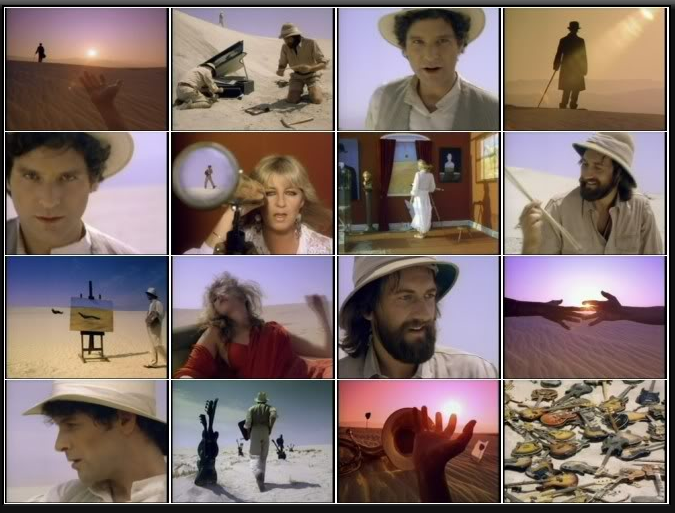
In the summer of 1982, with temperatures reaching more than 100 degrees, director Steve Barron (who had recently directed the classic video “Don’t You Want Me Video” for the Human League) took Fleetwood Mac to the Mojave desert to shoot the video for “Hold Me”; the video, like so many other videos from that era, makes little-to-no sense, especially when married to the song. John McVie and Mick Fleetwood goofily “play” archaeologists unearthing ancient guitars. As Christine spies through a telescope, Lindsay paints Stevie in the blistering heat, then Stevie paints Stevie in the blistering heat, who then in turn, traipses across the desert in her red platform boots carrying her canvas. It was/is all quite ridiculous, but the video was a huge hit for MTV at the time and remains a fan favorite.
Barron directed other classics of the early days of music videos, such as a-ha’s “Take On Me” and Michael Jackson’s “Billie Jean”, but “Hold Me” is inexplicably left off of his Wikiepedia page.
In this rare behind the scenes dailies, Barron directs a breathtakingly beautiful Stevie Nicks for some of her scenes in the video. Stevie’s was the only footage I was able to unearth. The clapper board dates this as June 24, 1982.
I cannot remember a time in my life where I could sleep in silence. To drift into timelessness, there must be the delicate sounds of human language…music never helped either, and still doesn’t…it has to be conversations in the dark, like angels converging in my timespace. Now, and since the genesis of my adulthood, I sleep with the television playing old reruns through the night (until Rob comes to bed and shuts everything down), but as a teen, with no TV in my room, I would drift into dreamland by listening to talk radio or, in many cases, the local all news station.
And I heard it in the middle of the night, awoken while listening to New York’s all-news 1010 WINS…and I was paralyzed. Was this a nightmare? I tended to drift between reality and dreamscape, sometimes unable to momentarily grasp the difference between the corporeal and the intangible dreams…
No, this had to be merely the night terrors, brought on by the incessant tick-tick-ticking of WINS’s archaic background sound effects. I jettisoned out of bed, ran to the bathroom, splashed my face with water and sighed, lumbering back into the sanctuary that was my bed on the floor. But I had to be sure. So, I listened again.
And I wept in the silent hollow of the night. How can John Lennon be dead?
The next school day was a day of mourning, as students and fans sat around the piano in the auditorium singing the songs the world knew. No one could believe that he was gone…murdered…why a man who lived his life for peace and love would be so mercilessly executed. In hindsight, and to anyone not born of that time, this might all seem a bit idealistic, but it served the youth of the world back in the prehistoric, pre-Internet era of 1980.
It’s unfathomable that almost three decades have passed since madman Marc David Chapman put a bullet through the very fabric of an era.
The world lost not only a philanthropist, but those who loved his music, his philosophy and his inherent goodness also lost a fabric of their innate being.
And, more tragically, a woman lost a husband and a little boy lost a father.
The abundance of tracks that were recorded during the sessions that begat the John Lennon/Yoko Ono classic DOUBLE FANTASY were supposed to be released successively as sort of companion pieces, and in January of 1984 – four years after Lennon’s slaughter – Ono finally released MILK AND HONEY, accumulating John’s songs from those sessions with her (mostly) new songs. Musically it was a strange dichotomy – Lennon’s sonically unfinished tracks were hardly masterpieces, though there were some gorgeous moments. Ono’s newer tracks hinted at a more contemporary feel while subsiding (though not totally) her usual avantgardism for a more Pop sheen (though hardly Pop). Juxtaposed as the same call and response schematic as DOUBLE FANTASY, MILK AND HONEY, at times, loses a coherency. And I admired the collection for these exact reasons. Reviews were mixed, and many pondered the motives around Ono releasing this material (she talks about such in the interviews below).
For over four decades, Ono’s unfairly been a pariah to psychotic Beatles fanatics, Lennon-ologists and journalists, and still, to this day, by muttonheads who stupidly continue to espouse the “SHE BROKE UP THE BEATLES!!!” mantra like the 33 of “Revolution #9” played on 78 (forget that some of Lennon’s finest musical seeds were nourished after the dissipation of the Fab 5, thanks to Ono as inspiration).
What was – and is – almost always overlooked was their happily-ever-after. If anything at all, it was indubitable that John & Yoko were passionately in love with each other and their son, until sadly, what transpired was their Till death do us part.
Certainly, Ono was (and is) not unaware of the conspicuous disdain the majority of the public feels at the mention of her name or the mockery at the suggestion of her musicality – though I’m apt to believe most negative connotations, especially these days, come from a force of habit, as if it were merely common knowledge to loathe her – but she rarely, if ever (and certainly not during this interview) lets her guard down or lets the toxic forces imbibe her tightly sealed bubble (at the time of this interview, she’d had almost two decades of such barrages to have already built up massive invisible force shields).
Some also scoffed because this was a paid interview – Robert Christgau, the Dean of American Rock Critics, was commissioned to interview Ono by Ono herself, for this promotional film for MILK AND HONEY. In his weekly Village Voice Consumer Guide, dated March 24, 1984, Christgau wrote:
“* * * Attention * * * Disclosure * * * Attention * * * Before the goddamn Times finds out, I’ll do the apparently honest thing and note that I was paid by Yoko Ono to interview her for a promotional film she’s making about Milk and Honey. I took the job well after (and only because) I’d fallen for the album, though the interview clarified my ideas about it. For a while I considered not reviewing Milk and Honey, or keeping my opinion off in some discreet corner, but in the end it seemed stupid, not to mention ethically dubious…”
Christgau gave MILK AND HONEY an “A” grade in his Village Voice Consumer Guide.
Besides Yoko, Christgau also interviews Sean, who at the time was a precocious 9-year old, wise beyond his youth. But these interview segments are fairly brief, and woven with home movies of Lennon and Ono and Sean (some of the footage I’ve never seen) that are both wondrous and heartbreaking. They exist as aural and visual paintings – from “Nobody Told Me” to “Borrowed Time,” to “Grow Old With Me” to “I’m Steppin’ Out.” Presented almost as music videos, these are rare glimpses of a sojourner’s happy past and present that numbs in the realization that he – and we, and Yoko, and Sean – were robbed of a spirited, almost assuredly monumental, enchanted future.




 My New Boyfriend